Showing posts with label Renaissance. Show all posts

Sunday, September 9, 2012

The Renaissance 101

This is a post that came from another blog of mine which recently went private. I have written here before a very brief introduction to the Italian Renaissance, and this is simply an extended version of that. I find the Renaissaance absolutely delish, as I'm sure you will! Who can resist Medicis, humanism, Michelangelo and so much more???


I'm going back to my roots as a history student and teacher and blogger of historical fiction to bring you the first of a series of posts on the Italian Renaissance. I'd like to just state for the record that if you found yourself here by googling the term "italian renaissance" by all means use these posts as background information and although I am a qualified teacher of the subject I am not a published author so you probably shouldn't source me in your bibliography. Most of the info comes from my own brain but if I'm referring to someone else's ideas, etc, I'll source it for you, with a link where possible.

And this work of mine is copyrighted 2010 so please don't cut and paste this info into your papers as that's just plagiarism and really not cool. Plus my own musings will probably come into it, as will any side comments and totally biased opinions I may have that you may not necessarily share. So go the hard yards, do the research and write the darn thing yourself!
If you have any questions though or want ideas on books or other sources please email me. Oh, one more thing - if it's the French Renaissance you're looking for this blog here is really great.

So let's begin.

The Italian Renaissance is generally considered to begin in the late 14th century (after the Black Death) and end during the middle 16th century (around the beginning of the Reformation). It refers to a time of great cultural and social change as European society moved out of the Middle Ages and into a new era of enlightenment and change. The term renaissance is a French one meaning reborn. In Italian the term is il rinascimento.

The Italian artists and writers of the late 14th century Giotto, Boccaccio, Petrarch and Dante are considered amongst the forerunners of the enlightened souls who were at the birth of the Renaissance. Although these men came from different places it was the city of Florence where they found patronage and acceptance.

Florence is often called "the cradle of the Renaissance" because it was the city that most strongly supported the development of new ideas and encouraged the looking back to antiquity. Fundamentally, the Renaissance examined the literary works of the ancient Greeks and Romans, works that had long lay doramnt in the minds of the medieval Europeans. These works included Plato, Aristotle, Socrates, Homer, Cicero, Pliny, Plutarch, amongst others. These ancient writers were revived and revered by the new emerging writers of the 14th century and hailed as literary and artistic inspiration. Much of the works written, painted, sculpted and otherwise created during the Renaissance take their inspiration not only from the writings of ancient Greeks and Romans but also from Greek and Roman mythology.

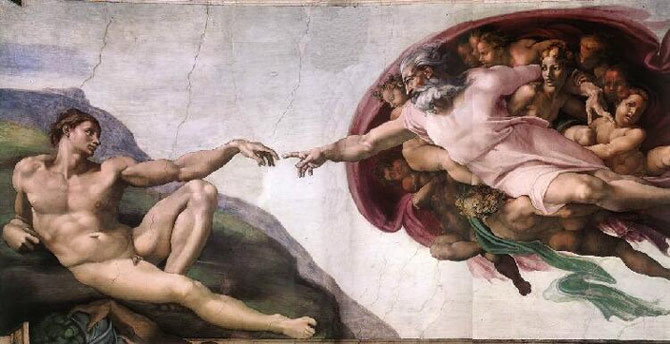
Some of the most prominent artists during the Italian Renaissance include Michelangelo Buonarotti famous, amongst other things for his painting of the Sistine Chapel (and the glorious Creation of Adam scene) The Sistine Chapel (ceiling) - Michelangelo Buonarotti - 1508-1512

and his giant statue David;

Sandro Botticelli of La Primavera and The Birth of Venus fame The Birth of Venus - Sandro Botticelli - c1485-87

Donatello, Masaccio, Domenico Ghirlandaio, Filippo and Filippino Lippi and Giovanni Bellini.

The architect Filippo Brunelleschi is the genius behind the dome of the Santa Maria del Fiore in Florence, a creation that astounded artists, humanists and mathematicians alike. His development of linear perspective was crucial to Renaissance architecture. And truly, he was the only one who could get that enormous dome to stay put on top of the church. A competition was run and his design was chosen as the winning one - it was like the X Factor of the 15th century!


One of the most significant and influential figures of the Renaissance is of course, the world-famous, incomparable, omnipotent, Leonardo da Vinci. Artist, sculptor, writer, engineer, inventor, mathematician, physicist, and more, da Vinci took the notion of a renaissance man to a whole other level. His level of genius and the contributions he made not only to Florentine society (in fact despite being trained there very little of his working life was spent in Florence) but to Italian society as a whole are staggering. It is, however for the following work that Leonardo da Vince is so fondly remembered:

Mona Lisa - Leonardo da Vinci - 1503-1519

The notion of humanism is an important one in understanding the Renaissance but what exactly is it? That's a pretty loaded question that really requires a post all on its own (maybe one day, I've already got a ton of other renaissance-based posts planned). Basically, in a nutshell I suppose, humanism puts man at the centre of his (or her) own universe. Riding on the back of the Middle Ages and the Black Death where God and the Church were all, that the afterlife was the key to living this life, the people involved in the movement of humanism during the renaissance decided to start living their lives for themselves. Man is the measure of all things. An idea that man (and I use this term here in place of human - although women weren't necessarily an integral cog in the whole humanism/renaissance wheel they did play their part. But that is definitely another post for another time) could live his life as he wanted to, to enjoy the here and now and not necessarily focus on the afterlife as an end reward. They became active participants in the world around them, making contributions to society and being responsible for their actions.
Humanism also plays its part in the development of art during the renaissance. The book European Art of the Fifteenth Century explains "the humanists rediscover the values of moderation, reason and a sense of proportion."

One of the men most highly regarded as being a benefactor of humanism is Lorenzo de Medici.

Lorenzo de Medici - Andrea del Verrocchio, 1480

Lorenzo il magnifico was the grandson of Cosimo de Medici, a Florentine banker who was considered the grandfather of the renaissance. Lorenzo himself, however, is the one accredited with patronage and support of some of the city's finest artists, writers and humanists. As Francesco Guicciardini stated: "'if Florence was to have a tyrant she could never have found a better or more delightful one." (From, Hibbert, C. The House of The Medici: Its Rise and Fallp 157).
Lorenzo not only patronised and commissioned works he also supported the overseas expeditions that searched for the lost texts of the classical Greeks. Important historical occurences such as the fall of Constantinople in 1458 saw a huge influx of Greek humanists from Turkey into Italy and mainland Europe, some bringing with them books, artefacts and other important artefacts that brought the classics to the forefront of the renaissance mind.

The Women of the Renaissance


My research on women in the Renaissance has brought up a lot of surprising and interesting information. Jacob Burckhardt in his tome The Civilisation of the Renaissance in Italy made the rather sweeping statement in his chapter entitled The Position of Women: "To understand the higher forms of social intercourse at this period we must keep before our minds the fact that women stood on a footing of perfect equality with men."

This statement was taken at face value by historians for many years until the feminist movement in the 1970s when historians began to revise history and examine it also from a woman's perspective. Joan Kelly's Did Women Have a Renaisssance is one essay that raised the notion that indeed women were not on equal footing with their male counterparts.

Kelly illuminated the unique social position of Italy during the Renaissance: emerging from the Middle Ages and excelling in mercantile and manufacturing business it was more advanced in many ways than other European countries (please keep in mind that "Italy" as a country did not exist at this stage but was instead made up of many individual city states, republics and kingdoms - but that's a lesson for another day). She boldly states that these very advancements "affected women adversely, so much so that there was no renaissance for women - at least not during the Renaissance." (Women, history & theory: the essays of Joan Kelly, p 19 available from Google books ). Kelly examines women in a number of roles for her essay: female sexuality; economical and political roles; cultural roles (including education); ideology of women, in particular in art, literature and philosophy (ibid, p20).

In his equally fascinating book Women in the Streets: Essays on Sex and Power in Renaissance Italy Samuel K. Cohn Jr also looks at the decline of the appearance of women after the beginning of the 15 century. His study focuses on evidence from court and criminal archives, convent and dowry lists, and wills. It is an examination of women that delves so much deeper than merely the famous elite women of Italy delivered from a purely bourgeoise perspective. Women such as Sofonisba Anguissola, Catherine de Medici, Simonetta Cattani (beloved, but not wife, of Giuliano de Medici), and Lucrezia Donati (beloved, but not wife of Lorenzo de Medici) are women that are well known to the historian as elite, wealthy women who were able to participate somewhat in Renaissance society. The latter two are referred to as the "ideals of love." This was a common role for women belonging to the upper echelons of society and although Donati and Cattani were both married to other men, their public veneration by the Medici men was infamous. In fact, Lorenzo composed an early love sonnet to Lucrezia.

Catherine Lawless in her essay Women on the Margins: the 'beloved' and the 'mistress' in Renaissance Florence expounds further on this notion of "ideals of love". She also asserts that "Renaissance historians now know a great deal about wives, widows, mothers, nuns, tertiaries, anchoresses; even, although to a much lesser degree, about women who were poets and artists...women who did not fit into such clearly sanctioned, or perhaps it is more true to say, clearly defined roles have received little attention." (From Studies on medieval and early modern women: pawns of players, co-authored with Christine Meek, Four Courts, 2003 and available online at Three Monkeys Online

K.J.P Lowe's work Nuns' chronicles and convent culture in Renaissance and Counter-Reformation Italy (Cambridge University Press, 2003) was a look into the lives of a somewhat forgotten and often ignored group of women in Renaissance history. It is insightful and has assisted me in developing a believable and historically accurate portrayal of Le Murate, or the Convent of Santa Annunziata where I have set my novel.

The role of women in Renaissance Italy and in particular Florence is an important one to the student of the Renaissance and it is worth investigating further. To accept Jacob Burckhardt's dated and now incorrect statement is an easy out for the student of history and further, deeper investigation is required (as is often the case in women's history) to truly understand the complex and diverse roles of women during this time. I hope these sources and this brief essay has helped those of you who are wishing to delve deeper and really examine closely the women of the Renaissance.

Venice - City of Excellence


This post has come from another one of my blogs which has recently become private. I moved many of the history articles from there over to here so that people can still access my bite sized pieces of history. Please forgive me if these ones are slightly overflowing from the plate, they weren't designed for the History Harlequin's purpose of quick, snippets of history.


I have had the immense pleasure of visiting Venice of couple of times, each time in winter. It wasn't as crowded as I hear it gets in the summer months and we were able to move through it fairly easily. The first time was with a fellow Aussie traveller, the second was with a group of students I knew when I was studying in Padova. There were a couple of Italians amongst us, which made the trip even better. Travelling around a country with a native of that country is a really great way to see the real thing. You know, when you're a tourist with Lonely Planet thrust tightly under one arm, phrase book in the other, you miss most of the good bits trying to get to the place where all the tourists are.

When I went with the group of students we wound up in a little cafe that served delicious warm red wine, glorious hot chocolate (thick and bitter - delicious!), sensational antipasto and more. I have no idea what it was called or if I'll ever end up there again. I think it may have been near some water. Down a dark, quiet alley. Hmm....


I remember this was the trip where I tasted salted licorice for the first time (yuck!), made fun of the raucous American students with their fancy cameras around their necks with my Swedish friend Steine and dodged the attentions of an Italian named Zeno who I knew had a Mexican girlfriend.

Anyway, this post isn't just about my more than enjoyable trips to the capital of the Veneto, it's also a look at a book that I have, called Venice Cità Excelentissima: Selections from the renaissance diaries of Marin Sanudo.


Source: The Book Depository

When I discovered this book on Google books last year needless to say I was very excited. One of the things about being a historical writer is finding primary sources that cover the topics pertinent to your story. Sanudo kept his diaries from January 1 1496 to 1533. He tried several times to give away his journal writing, but luckily for us historians, he was convinced otherwise.

Sanudo's work covers an enormously broad range of topics including Venetian government, crime and justice, war and diplomacy, economics, social life, religion and superstition, humanism and the arts, theater and much more.

Sanudo's account of life in Venice during the Renaissance is so comprehensive that for the first time, in all the many and diverse lives of Finding Orpheus I am considering changing the location of my story from Florence to Venice. Sanudo paints such a vivid picture, such inspiring first hand accounts that the information available to a novelist to create a realistic and historically accurate setting is hard to resist.

And Venice too has such a romantic image, being on the islands, with their dark, secret alleyways, the quiet lapping water that holds a myriad of secrets and mysteries. It also stands so close and in such contact with the mysterious and dangerous Ottoman Empire, something that snakes its way into my character's lives.

Who knows Ana and Giovanni may well end up in Venice sometime in the future. The killer that they are facing may lead them there. Or some other circumstance.

For those of you who are interested in the renaissance in Venice though, you can't go past Sanudo's diaries.

Wednesday, April 6, 2011

Leaders and Rulers


                                      Ludovico Sforza, Zanetto Bugatto

During the mid-1300's and early 1400's, a number of major Italian cities came under the control of one family. For example, the Visconti family governed Milan from the early 1300's until 1447, when the last male member died. Soon after, the Sforza family took control of Milan and governed the city until the late 1400's. Other ruling families in Italy included the Este family in Ferrara, the Gonzaga family in Mantua, and the Montefeltro family in Urbino.

The form of government established by the ruling families of the Italian cities was called the signoria, and the chief official was known as the signore. All power was concentrated in the signore and his friends and relatives. An elaborate court slowly grew up around each signorial government. At the court, the area's leading artists, intellectuals, and politicians gathered under the sponsorship of the signore.

Other Italian cities had a form of government known as republicanism. In republican cities, a ruling class controlled the government. Members of the ruling class considered themselves superior to the other residents of the city. The most important examples of republican government were in Florence and Venice.

In the republican government of Florence, about 800 of the city's wealthiest families made up the ruling class. The members of these Florentine families intermarried and lived in large, beautiful palaces built by Renaissance architects. They paid for the construction of great religious and civic buildings and impressive monuments throughout Florence. They also supported artists and intellectuals. In addition, the ruling class encouraged the study of ancient Greek and Roman authors in the desire to have their society resemble the cultures of classical antiquity.
 
Cosimo de Medici, Jacopo da Pontormo, 1519
By the 1430's, the Medici family dominated the ruling class of Florence. The family controlled the largest bank in Europe and was headed by a series of talented and ambitious men. Under Medici domination, the government of Florence resembled a signorial government.

About 180 families controlled the republican government of Venice. All government leaders came from these families. A law passed in 1297 restricted membership in the Great Council, the principal governing body, to descendants of families that had already sat in the council. Like Florence, Venice became a leading center of Renaissance art under the support of the ruling class.

Friday, March 25, 2011

The Renaissance

If you don't know what the term renaissance  refers to you may find many of the festivals and fairs that dot the western world all year round slightly confusing. They may also be in the Eastern world but at the time of writing I am unaware of any.
So just so you don't seem like a nincompoop at said fairs, here's a little taster of the Renaissance. Simply drop some of these names and facts and you should be alright. Well, left alone at least.

The Renaissance traditionally refers to the cultural, philosophical and social movement that began in Florence at the end of the 14th century (after the Black Death) and continued sometime until the middle of the 16th century. It spread through the rest of Italy, France, Germany, the Netherlands, England and parts of Spain.

The term itself is French and means reborn. In Italian reborn is il rinascimento. What was being reborn was the art, history, philosophy and attitude of the classical age of Greece and Rome. After the Dark Ages (or the Middle Ages, a term I prefer because if you look deeply they really weren't so dark as their reputation implies) Europe underwent a massive shift in thought and culture which permeated then through all aspects of society.

 The Birth of Venus - Sandro Botticelli c1485-7
The rediscovery of texts and manuscripts from Greece (especially after the Fall of Constantinople in 1453) and those from the Middle East (where society was undoubtably more advanced and sophisticated during the Middle Ages) brought a lot of new, and old, ideas to Europe.

Some of the key characters who were interested in this transformation and contributed to it (either willingly or unwillingly) include:

Writers - Dante, Petrarch, Boccaccio
Artists - Giotto, Sandro Bottecelli, Michelangelo Buonarotti, Donatello, Rafael, Leonardo de Vinci (yes, the Teenage Mutant Ninja Turtles were actually named after quite important people). There are of course many more but this is only meant to be an appetiser, not the whole main course.
Leaders - Cosimo de Medici (Florence), Lorenzo de Medici (Florence), the Sforza family - notably Ludovico and Caterina (Milan), the Este family (Ferrara, and other parts of Veneto), Queen Isabella and King Ferdinand  - of the Spanish Inquisition fame (Spain), Phillip II of Spain (Spain, Naples, Portugal), Henry VIII (England), Elizabeth I (England)
Religious Movers and Shakers - Savonarola, Martin Luther, Sir Thomas More
Popes  -  Pope Innocent VIII, Alexander VI, Julius II, Leo X
Scientists - Nicolaus Copernicus (good old Copperknickers - sorry couldn't resist), Leonardo da Vinci, Galileo, Galilei
Political Commentators  - Machiavelli


The Sistine Chapel (Ceiling) - Michelangelo, 1508-1512

Alright, this plate of hors d'oeuvres is starting to overflow a bit here, and as my aim is simply to whet your appetitie I'm going to stop here. Keep tuned though as I'm sure some of those mentioned here will bubble up into their own tasty portions.